A apresentar mensagens correspondentes à consulta porsche ordenadas por relevância. Ordenar por data Mostrar todas as mensagens

terça-feira, 11 de abril de 2017

The new 2018 Porsche 911 GT3


The new 911 GT3 was born in Flacht. The road has been its home – and its school – since day one. So, then, what should become of it?

An unadulterated sports car, naturally. One that breathes motorsport and defies the tarmac. A race car that pushes its drivers into their Sports seats more firmly than they would ever have imagined possible.


Many have still never heard of it. Some believe it’s all just a myth. For the true fan, though, behind the idyllic green hills of the Swabian region in Germany the promised land does exist: Flacht. The home of Porsche Motorsport. Our home. The place in which the Porsche heart beats the fastest. Where the transfer from motorsport into series production is routine daily practice. Where the proving ground is our playground. And precision is our greatest passion.


Here, in Flacht, is where the new 911 GT3 turned its first laps. Here is where the mighty sound of its 4.0-liter horizontally opposed and naturally aspirated engine roared for the first time. Here is where the chassis was tuned over the course of countless test kilometer with the meticulous scrutiny only otherwise afforded to the Porsche 919 Hybrid for Le Mans.


Our engineers invested all their racing experience into it, tweaking and honing into the night. Afterwards, they would all say: “It couldn’t get any better.” Only to ask themselves the next morning: “Could we not make it even better?” A hundredth of a second faster, a percentage point more agile, a gram lighter?


Aerodynamics and design

The greatest resistance we know here in Flacht? Headwind. It’s a matter of confronting it – with optimum aerodynamics and favorable drag coefficients. But it’s also a matter of exploiting it. By using it to cool the brakes, for example – or as a supply of combustion air. And, of course, to generate downforce on the racetrack.


How do we reconcile these most conflicting of parameters? With a harmonious overall concept. And, of course, a design in which every detail must demonstrate its functionality first and foremost.


The new front end of the 911 GT3 makes one thing instantly clear: this car is not here simply to make up the numbers. Large openings left and right, together with new airblades on each side, improve cooling. Even the customary 911 GT3 air outlet to the front of the luggage compartment lid helps to ensure plenty of fresh air.


All cooling air intakes are protected by air intake grilles in titanium colour.
Responsible for the leaner build: lightweight polyurethane with hollow glass microspheres and carbon-fiber elements. The complete front end is made from this light yet extremely robust high-tech material. Responsible for the extra downforce at the front axle: the wide front spoiler lip.

Responsible for clear vision: Bi-Xenon main headlights, fitted as standard, including dynamic range control and headlight cleaning system. LED headlights are available as an option. Direction indicators, daytime running lights and position lights, all designed with LED technology, have now been made even sleeker – leaving a larger surface area for the air openings.


The first impression is like the second: the new 911 GT3 has a more imposing appearance. And always looks ready to pounce. More aggressive as well? We prefer to say: more impatient. At least for those on the racetrack who see it approaching in their rear-view mirror.


Squat is how the rear looks. And squat is also its stance on the road. That’s because the 911 GT3 is an extra 44 mm wider and sits approximately 25 mm lower than the 911 Carrera. It’s because the LED taillights are not only slimline, they are now also shaped three dimensionally. It’s because the central twin tailpipe of the sports exhaust system is a visual clue to the car’s low center of gravity.
Like the front, the revised rear end is also manufactured from lightweight polyurethane. The rear lid, wing and wing uprights are in carbon. The central air outlet slit is larger and positioned higher than on the predecessor model. The two black-finish ram-air scoops on the rear lid supply the engine with combustion air.


A trademark of the GT models and a pointer in the direction of motorsport: the fixed rear wing. It is approximately 20 mm higher than on the predecessor model. For a further gain in downforce.
Four additional fins at the rear of the underbody panelling reinforce the aerodynamic effect of the diffuser. And they also appear to pull the new 911 GT3 down closer to the racetrack. Especially to those who just saw it overtake.


Performance

The engine of the new 911 GT3 is not meant as a friendly Swabian gesture, but as a throwing down of the gauntlet. To everyday life. To physics. But, above all, to all the other drivers on the racetracks of this world.


Brief for the new engine: naturally aspirated engine from motorsport, low down in the rear, six cylinders, horizontally opposed pistons. A full four liters of displacement. And high performance potential with unadulterated sound.
The new drive unit was developed – where else? – in Flacht. Particularly robust and powerful, it is based on the engine fitted in the 911 GT3 Cup.


The oil supply principle, which uses a separate engine oil tank, and the concept of four valves per cylinder with cam followers and rigid valve train have also been derived directly from motorsport.
From its impressive capacity of 3,996 cm³, the engine draws a maximum power output of 368 kW (500 hp). With Porsche Doppelkupplung (PDK), fitted as standard, the sprint from 0 to 100 km/h takes just 3.4 seconds and top track speed is 318 km/h. With the optional 6-speed GT sports manual transmission*, the time is 3.9 seconds. Top speed? Not reached until 320 km/h.
At Porsche, natural aspiration also means a high-revving concept. The needle in the 911 GT3 doesn’t hit red until 9,000 rpm. Maximum torque is 460 Nm – some 20 Nm more than is offered by the predecessor model. It is available at 6,000 rpm, while maximum power output is achieved at 8,250 rpm.


As far as the efficiency of the engine – and its power output – is concerned, direct fuel injection (DFI) makes a decisive contribution. It does so with millisecond precision and a pressure of up to 200 bar. For optimum mixture formation and combustion in the combustion chamber. And, relative to the engine’s high power output, it helps to achieve favourable fuel consumption and comparatively low CO2 emissions.
*Provisionally available from 09/2017
VarioCam
VarioCam is an engine timing concept that distinguishes between various engine speeds and load states so that timing can be adapted to suit the current power demand. It regulates not only the adjustment of the intake camshafts but also the exhaust camshafts in order to deliver increased power and torque.
Adjustment takes place imperceptibly under the control of the electronic engine management. The result is very smooth running and, above all, high power and torque across the entire engine speed range.
High-revving concept
The valves are operated by cam followers – a principle derived from motorsport. Clearance compensation between the camshafts and valves of the new 911 GT3 is realized not by hydraulic means, but by shim plates as part of a solid arrangement. This kind of valve timing design provides greater robustness and enables remarkably high engine speeds even under hard use.

Interior

The interior of a sports car is like an athlete’s clothing: it must fit perfectly and feel like a second skin. Only then can human and machine function as a single, sporty entity. To deliver superlative performance, the driver needs information that can be accessed quickly and an interior ergonomics concept that enables even faster use of it.


The requirement is fulfilled by an ascending center console that places the gear selector within direct reach of the steering wheel, by ergonomic gearshift paddles on the steering wheel itself and by conveniently positioned controls that dispense with unnecessary gadgetry but do open up new possibilities on the racetrack. Over 30,000 racing victories were not achieved by engine power alone.


Instruments
Precise not fanciful, minimalist not trendy. True to Porsche style, the five round instruments integrated into the cockpit lead the way. The rev counter resides in the middle. Its dial is titanium colored and bears the ‘GT3’ logo.
The instrument cluster with 4.6-inch color screen provides you with a continuous stream of data from the on-board computer, including average speed and fuel consumption, fuel range and outside temperature, and allows you to view Tire Pressure Monitoring System (TPMS) information as well as the stopwatch of the optional Chrono Package. It also reminds you of your selected communication and audio settings or displays the map of the navigation system – but only for the rare occasion you aren’t on the racetrack.


Specs


Engine


Manual PDK
Cylinder layout / number of cylinders 6 6
Displacement 4.0 liters 4.0 liters
Horsepower 500 hp 500 hp
@ rpm 8250 rpm 8250 rpm
Torque 339 lb.-ft. 339 lb.-ft.
Compression ratio 13.3 : 1 13.3 : 1


Performance

Manual PDK
Top Track Speed 198 mph 197 mph
0 - 60 mph 3.8 sec 3.2 sec

Price

 $ 143,600.00

In motion


See it in motion in the video bellow:


Source: http://www.porsche.com/usa/models/911/911-gt3-models/

quinta-feira, 2 de março de 2017

Porsche 918 Spyder

 918 units, all sold, 2,5 million!

 What moves it?


Three motors, a 4.6 liter V8 and two electrical motors summing around 900HP is what you get with the most recent hypercar from Porsche. Porsche 918 Spyder is a hybrid hypercar, like a modern F1. Some say that is one of the Hypercars Trinity, alongside with the LaFerrari and the McLaren P1.


The 918’s in-gear performance is unrivalled. What’s so astonishing is not just the pace but also the flexibility afforded by its rampant electric motors’ instant torque. All wheel drive, a perfect balance and an astonishing sound, is a beast in the asphalt!


To accelerate from both 20mph to 40mph and 30mph to 50mph in second gear, a 918 Spyder needs 1.0sec. A P1 wants 1.3sec and 1.1sec over the same marks The Spyder can go from 0-62mph (0-100 Km/h) in just 2.5 seconds and has a top speed of 210mph (around 345 Km/h).


Former F1 pilot  Mark Webber in its 918 Spyder, picture bellow:


What's inside?


The interior is all about offering the driver a great driving experience. There is an ultra-modern center console that looks like something out of a futuristic movie and a trio of rounded, standalone gauges. It is divided into two basic areas: one holding the controls that are important for driving and grouped around the multifunction steering wheel and the infotainment block that is housed in the lifted center console.


How quick it runs?


See for yourself in the video bellow, running around Laguna Seca circuit challenged by the P1:


quinta-feira, 23 de fevereiro de 2017

Ferrari LaFerrari


The oddly-named Ferrari LaFerrari is the latest in a long line of technologically-advanced hyper-cars from the Prancing Horse. Limited to just 499 examples , the LaFerrari (a name that literally translates to "The Ferrari" in Italian) stands out as Ferrari's first street legal gasoline-electric hybrid.


At its core, the LaFerrari uses a 789-horsepower 6.3-liter V12 engine capable of revving to 9,350 rpms. From there, the engine is coupled to a 120-kilowatt electric motor which bumps total maximum output to 949 horsepower and 663 lb-ft. of torque. Two electric motors are actually on board - one to power the driven wheels and one to run ancillary devices.


Power is sent to the rear wheels via a F1-grade seven-speed dual-clutch transmission controlled by shift paddles mounted behind the steering wheel. With both power sources running, the LaFerrari is capable of sprinting from zero to 62 mph in less than three seconds, from zero to 124 mph in less than seven seconds and reach a top speed of over 217 mph.
Huge carbon ceramic Brembo brakes hidden behind 19-inch wheels up front and 20-inch wheels out back help bring the car to a stop.


F1-Sourced Tech


The LaFerrari's HY-KERS hybrid drivetrain is modeled after the system found in Ferrari's Formula 1 cars. Attached to the floorboards, the 132-pound battery pack helps lower the LaFerrari's center of gravity and enabled engineers to place 59-percent of the car's weight on the rear axle.


The battery pack is recharged during braking - even when ABS kicks in - as well as when excess torque is being produced such as during hard cornering. The electric motors powered by the pack lower gas mileage and improve performance but they cannot drive the car by themselves like the ones found in competing cars built by Porsche and McLaren.


Cheating The Wind


A blend of form and function, the LaFerrari was conceived to be as aerodynamic as possible with the help of a wind tunnel typically used to design Formula 1 cars. It borrows some styling cues from the Enzo, its predecessor, and others from current members of the Ferrari lineup like the F12berlinetta.


Aerodynamics

 
Active aerodynamic devices such as diffusers on both ends, a spoiler out back and guide vanes integrated into the underbody generate downforce when needed and help the LaFerrari cheat the wind. A wide array of sensors work to deploy the devices automatically without any input from the driver.


It boasts an aggressive appearance with large air dams up front, a F1-like nose cone and a wide rear end characterized by two round tail lamps and four exhaust tips.

Driver-Focused Cockpit


The LaFerrari's cockpit is accessed via doors that swing upwards. Continuing the Formula 1-inspired theme, the steering is commanded with a flat-bottomed steering wheel that groups every major command including switches for the turn signals, the headlights and the windshield wipers, a knob that enables the driver to select from five different driving modes and a button used to start the engine. The climate control knobs are conveniently located on the dashboard.
The car is equipped with a digital instrument cluster consisting of two high-definition color screens and a large tachometer mounted front and center. The driver can configure the information displayed by the two screens.


Interestingly, the LaFerrari's driver seat is tailor-made and cannot be adjusted, but the driver can change the position of the pedals and the steering wheel. Ferrari used input from drivers Fernando Alonso and Felipe Massa to create a driving position that is similar to that of a single-seater race car.

See it in motion


Key Competitors


The LaFerrari's main competitors in terms of price and performance are the gasoline-electric Porsche 918 Spyder and the 903-horsepower McLaren P1. That being said, all three cars are sold out.


quarta-feira, 1 de março de 2017

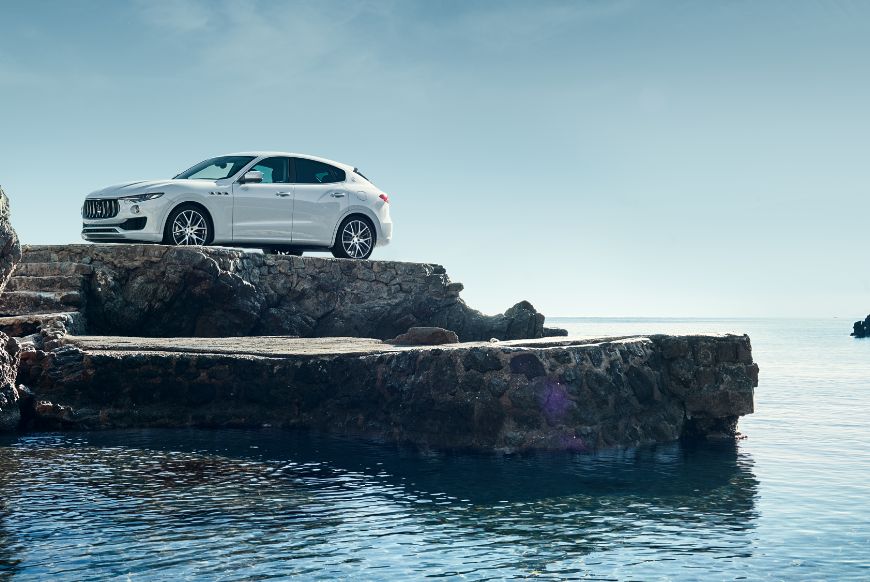
Maserati Levante


High-specification features for new heights of luxury 

Luxurious and adventurous, the Levante provides the highest levels of comfort whilst delivering outstanding performance even in the most extreme conditions. There’s no shortage of space or performance either. All versions come with an eight-speed gearbox, Maserati’s sophisticated intelligent Q4 AWD and a torque vectoring system for a truly exhilarating drive. 

The Levante is an SUV like no other, embodying the passion, the sophisticated engineering and exclusivity that have distinguished every vehicle engineered and crafted by Maserati in the heart of Italy since it was founded in 1914.

Powered for performance 

The Levante is a genuine SUV that performs under pressure and responds to your every need. Innovative, cutting-edge technology and engineering sophistication are the cornerstones of the outstanding 3.0 Twin Turbo V6 petrol engine, delivering incredible levels of performance and a max of 350 HP, while providing reduced fuel consumption and CO2 emissions.


The Interior


quinta-feira, 11 de maio de 2017

Zenvo TS1 GT - named ‘Sleipnir’

Zenvo Automotive presents the '10th Anniversary TS1 GT'


The car is a unique, one-off, bespoke TS1 GT which has been built specifically to celebrate the 10th anniversary of the company. Zenvo has specified and built the car to reflect the heritage of the company and its founders from Denmark. This historic TS1 GT has been named ‘Sleipnir’ [pronounced: “Sleep-near”] after the eight-legged horse ridden by Odin, the King of the Norse gods in ancient Scandinavian mythology. Sleipnir was ‘the fastest and best horse among gods and men.’


The recognition of the heritage of Scandinavia and its historical significance does not stop there. This very special TS1 GT has been painted in ‘Fjord Blue’ and highlighted by copper-bronze strips on the hood and roof of the car which are set into the bare carbon-fibre panels as well as contrasting copper highlights both inside and outside of the car. The use of copper-bronze recognizes the technological advancements by ancient Danes in exploration, trading and commerce extending from North America to Russia and the Middle East. In the pre-history of Scandinavia, Bronze was the most advanced material available. It was used in multiple applications including the design and building of chariots. Bronze was the carbon-fibre of its age and provided a technical advancement which allowed the unparalleled growth of the Vikings and the Scandinavian region.


The application of advanced technology within the region continues with the production of some of the most technically advanced hypercars in the world. Using extensive lightweight carbon-fibre and other hybrid composite materials as well as a unique proprietary drivetrain with ultra-fast advanced gear-shift, traction control and ESC technology, the quality of Zenvo engineering and the precision quality of production are the worthy successors of our innovative ancestors.
 

“Presenting this car at Geneva and celebrating our tenth anniversary makes me very proud and humble”, said Troels Vollertsen, Technical Director and Founder of Zenvo Automotive A/S. “We have achieved so much with a small team of highly dedicated and capable individuals. All of us recognize our heritage as pioneers of technology and remain totally committed to continue to produce and develop Zenvo cars which provide our owners and drivers with a sensational experience of performance, quality and perfect driving pleasure which is the DNA of our brand and our cars. We look forward with great excitement to the next ten years.”


The heart of the beast


The TS1 GT is a technical tour-de-force and our Hyper GT.  Using Zenvo’s extraordinary 1,163bhp engine with twin superchargers, the TS1 GT incorporates a newly developed gearbox with Zenvo ultrafast gearshifts that change gears at speeds not far off a Formula 1 car.


The entire shift system and linked engine management software were designed in-house at Zenvo, The TS1 GT is the most awesome Grand Tourer capable of a limited top speed of 375kph and a 0-100kph of only 2.8 seconds but providing the most effortless and luxurious cruising comfort that can only be experienced in a Zenvo TS1 GT.


The Interior

 The interior is completely original with an asymmetrical design leather and carbon fibre.  Switches and instrument surrounds are in copper and rhodium with these parts alone costing the same as a Porsche 911R.  Every single part is individually handmade and hand finished over nearly 8,000 man hours.  There are no materials which could give the impression that this car is anything other than totally bespoke, a masterpiece of quality, detail and engineering made to measure, literally, for the customer.


ABOUT ZENVO AUTOMOTIVE A/S

The Company was formed in 2007 as a channel for the aspirations and ambitions of a small group of highly talented Danish engineers and designers with extensive experience gained from working with Italian and German automotive companies. Led by powertrain specialist, Troels Vollertsen, with the design and styling vision of ex-RCA graduate Christian Brandt, the team wanted to realise long-held passionate ambitions to build a car which combined the traditional skills of Danish styling design with German-derived high performance technology.


Functionalistic and immediately aesthetically iconic, the Zenvo ST1 was developed over six years to demonstrate the use of ultra-lightweight composite materials in the design realisation of a car capable of performing alongside contemporary iconic supercars. A uniquely designed and engineered engine of 6.9 litres was produced for the ST1 incorporating both supercharger and turbocharger delivering 1120PS in a car made extensively from Carbon Fibre but featuring an aluminium and steel safety cell which, when tested, provided the ideal passenger environment for safety and comfort.


In 2016 Zenvo presented their revised hyper-GT, the TS1 GT, along with its racetrack-bred sibling, the TSR. A completely new engine of 5.8L capacity with twin superchargers had been developed now producing more than 1165PS. The new engine boasts a dry sump and flat-plane crankshaft configuration allowing the engine to spin more freely, rev much higher, produce power more efficiently and be mounted lower in the body for improved handling. Uniquely developed software running the Zenvo-designed high performance gearbox provides one of the fastest-shifting powertrains in existence confirming the on-going technological progress of Zenvo Automotive.
 Source: http://www.zenvoautomotive.com/