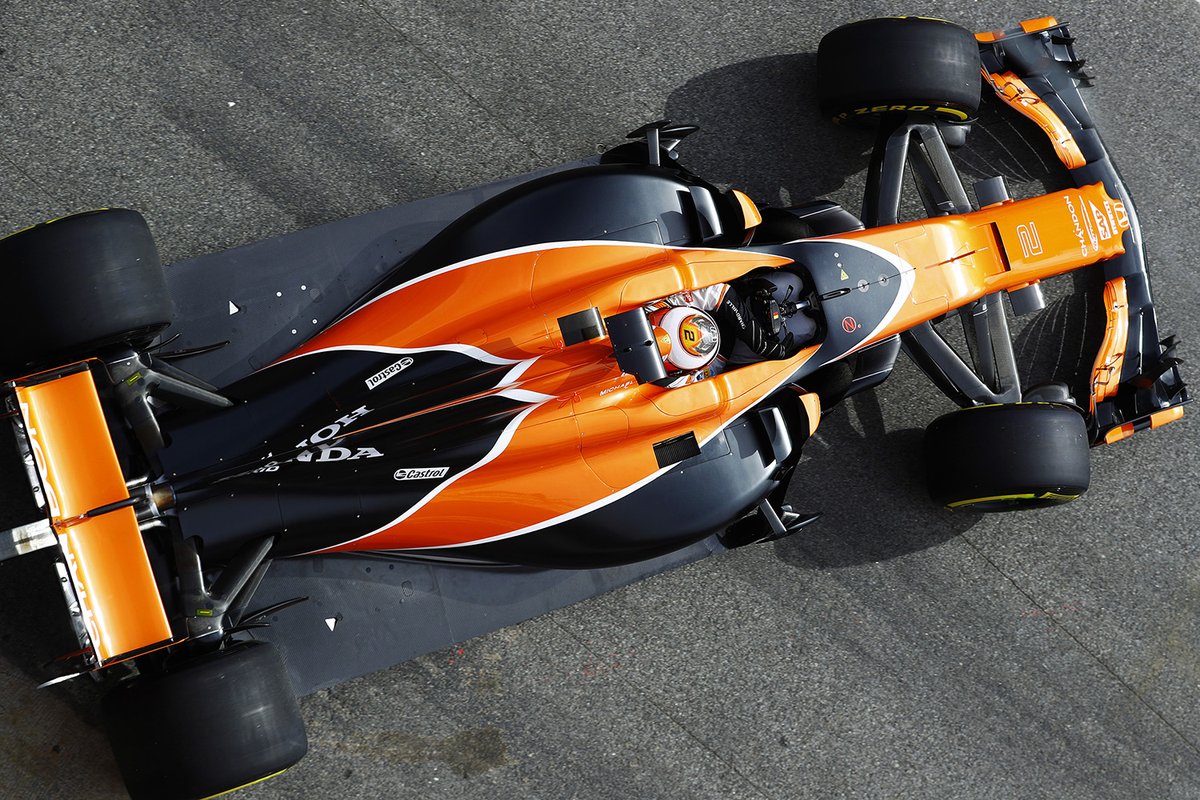
The McLaren MCL32 was revealed by the team on February 24th ahead of the 2017 F1 season.
It was the successor to the MP4-31, and the first McLaren since 1980
not to carry the ‘MP4’ designation, which was dropped following the
departure of Ron Dennis.
McLaren went into the third season of their second partnership with
Honda in their longest-ever win-less streak. The team’s last victory had
come at the end of the 2012 season, and the first race of 2017 would be
the third anniversar of their last podium appearance.
Significant changes in the F1 rules gave the team cause for optimism.
The widening of the cars handed an opportunity to the team’s chassis
designers to make up for more of the missing performance. And Honda had
made clear gains with its power unit in 2016, which promised to
accelerate as restrictions on engine development were eased for the new
season.
A further change for the team in the off-season was a change in fuel
and lubricants supplier. McLaren’s long-term relationship with ExxoMobil
came to an end and a new arrangement made to use BP and Castrol’s
products.
But while focus around the MCL32 will inevitably be trained on the
car's livery, it will ultimately be remembered - and judged - on its
on-track performance as the fallen superpowers strive to return to
winning ways.
"It's the engineering detail on the MCL32 that
really impresses me," said team boss Eric Boullier. "The chassis is
incredibly well realised, the power unit has been significantly
developed and, in Fernando and Stoffel [Vandoorne], we have a hugely
exciting driver pairing that's already blending really well.
"There's a feeling around the factory that we're about to turn the corner."
McLaren
showed signs of progress in 2016, their second season of a renewed
partnership with engine suppliers Honda, but need much more if they are
to jump from sixth in the constructors' standings to podium contenders.
Their
best result last season was fifth and F1's eight-time champions' last
victory came in 2012, but Alonso, preparing for his third campaign back
at McLaren, still insists he will be aiming for wins this year.
The
double world champion is joined by highly-rated Belgian rookie Stoffel
Vandoorne, who replaces Jenson Button as the Briton moves back to the
team's reserve driver.
The McLaren P1 is a limited-edition super car that blends a
gasoline-electric hybrid drivetrain with striking looks and
race-inspired technology in order to provide an unmatched driving
experience. Largely built out of lightweight materials such as carbon
fiber, the P1 is the spiritual successor to the iconic McLaren F1.
The P1's overall shape is reminiscent of the smaller MP4-12C but its
details are far more exotic. The P1 features a truncated front end with
a highly-stylized front fascia, butterfly doors, headlamps that mimic
McLaren's boomerang-shaped logo and flowing character lines that give
the car a look of motion even when it's standing still. Out back, the
P1 is characterized by a high-mounted center exhaust, a large spoiler,
meandering LED tail lamps and a functional air diffuser.
The finishing touch is added by 10-spoke wheels crafted out of
high-strength aluminum. Mounted on low-profile Pirelli P Zero Corsa
tires designed specifically for the P1, the wheels have a diameter of 19
inches in the front and 20 inches in the back.
Life Aboard
Designed as a driver's car, the P1 features an interior that is centered
around the driver and there are no unnecessarily switches or buttons to
be found on the dashboard. This creates a remarkably clean cockpit
that is seldom seen in the supercar world. A deep wraparound windshield
ensures the best possible visibility in all driving conditions.
McLaren went to great lengths to lower the P1's weight to a minimum and
the dashboard, the floors, the headliner, the door panels and the center
console are all crafted out of unpainted carbon fiber. To further push
the envelope, the top layer of resin on the carbon fiber has been
removed and the P1 does not come standard with carpet or sound deadening
material.
The two bucket seats are also crafted out of carbon fiber and filled
with as little foam as possible. They can only be manually adjusted
forward and backwards in order to avoid adding the unnecessary pounds
typically associated with multi-way adjustable setups.
In spite of its track-focused vocation, the P1 packs the usual
assortment of convenience features including full climate control,
satellite navigation and a Meridian sound system.
The instrument cluster consists of a 6.8-inch thin-film transistor (TFT)
central screen flanked on each side by a 3-inch TFT outer screen. The
three combined screens provide vital information about the P1's
drivetrain and surroundings as well as specific menus for the different
driving modes.
Under the Hood
The P1 is powered by a revised version of the twin-turbocharged 3.8-liter V8 engine that is also found in the engine bay of the MP4-12C.
The mill features a Formula 1-inspired dry sump lubrication system
and a low sited flat plane crankshaft that helps reduce the center of
gravity. By itself the eight-cylinder makes 727 horsepower and 7,500
rpms and 531 lb-ft. of torque from 4,000 rpms.
A 57-pound electric motor integrated into the V8 engine produces 176
horsepower and 190 lb-ft. of torque, providing an acceleration boost
when needed and helping offset the low-end lag typically associated with
turbochargers. The motor enabled McLaren engineers to use beefier
turbos than they normally would without worrying about creating
excessive amounts of lag.
Similar Cars
The electric motor gets juice from a 211-pound lithium-ion battery pack
designed with an emphasis on power delivery. Mounted between the seats
and the engine bay for better weight distribution, the pack can be
recharged using kinetic energy or in just two hours by plugging an
on-board charger into a regular household outlet. Alternatively, the P1
packs a world-first "pit lane charging" system that uses the V8 as a
generator to give the battery a full charge in just ten minutes.
The power generated by the V8 and by the electric motor reaches the rear
wheels via a seven-speed dual-clutch gearbox that can be controlled
with carbon fiber shift paddles mounted behind the steering wheel.
Driving Modes
The driver can select between three different driving modes: E-mode, Instant Power Assist System (IPAS) mode, and Active.
In E-mode, the P1 operates as an electric car that is cleaner and
quieter than most economy cars for a maximum of six miles at speeds of
up to 99 mph. The V8 kicks in automatically when the battery runs out
of electricity, charges it in as little as ten minutes and immediately
shuts off. In order to preserve energy, the he transmission shifts
automatically and cannot be controlled with shift paddles when E-mode is
engaged and overall performance is reduced.
IPAS mode delivers the drivetrain's full 903 horsepower and 663 lb-ft.
of torque, sending the car from zero to 62 mph in less than three
seconds and on to a track-worthy top speed of 217 mph. IPAS also lets
the driver use the Boost button on the steering wheel to instantly
deliver the electric motor's full output when the engine is close to
wide-open throttle.
Active mode is primarily designed to enhance the P1's track worthiness.
It unlocks a host of driver-activated features including sport and
track suspension settings, a Launch mode and a Race mode that lowers the
car and considerably stiffens the suspension.
The P1 comes standard with a vehicle lift system that raises the
suspension in order to avoid scraping the underbody on low ramps.
Key Competitors
Production of the P1 is limited to just 375 examples and every example has been spoken for. Its main competitors are the Ferrari LaFerrari, the latest masterpiece from the Prancing Horse brand, and the Porsche 918 Spyder, Stuttgart's newest halo car, but both are also sold out.